Computer vision system with transfer learning for automatic recognition of Dutch bird species
Computer vision app for birdwatchers to identify 7 Dutch bird species via photos. MobileNet transfer learning model trained on custom dataset of 2800+ images collected with Google Image Scraper. Completed full product development cycle from data collection to Figma prototype with A/B testing. The project combines technical model development with user-centered design for a mobile app.
Working with limited training data (400 images per species) required smart use of transfer learning and data augmentation. Visually similar bird species like blue tit and great tit were difficult to distinguish and required careful feature extraction. Manual data curation of all scraped images to guarantee data quality was time-consuming. Finding balance between model accuracy and mobile deployment efficiency (MobileNet vs heavier architectures).
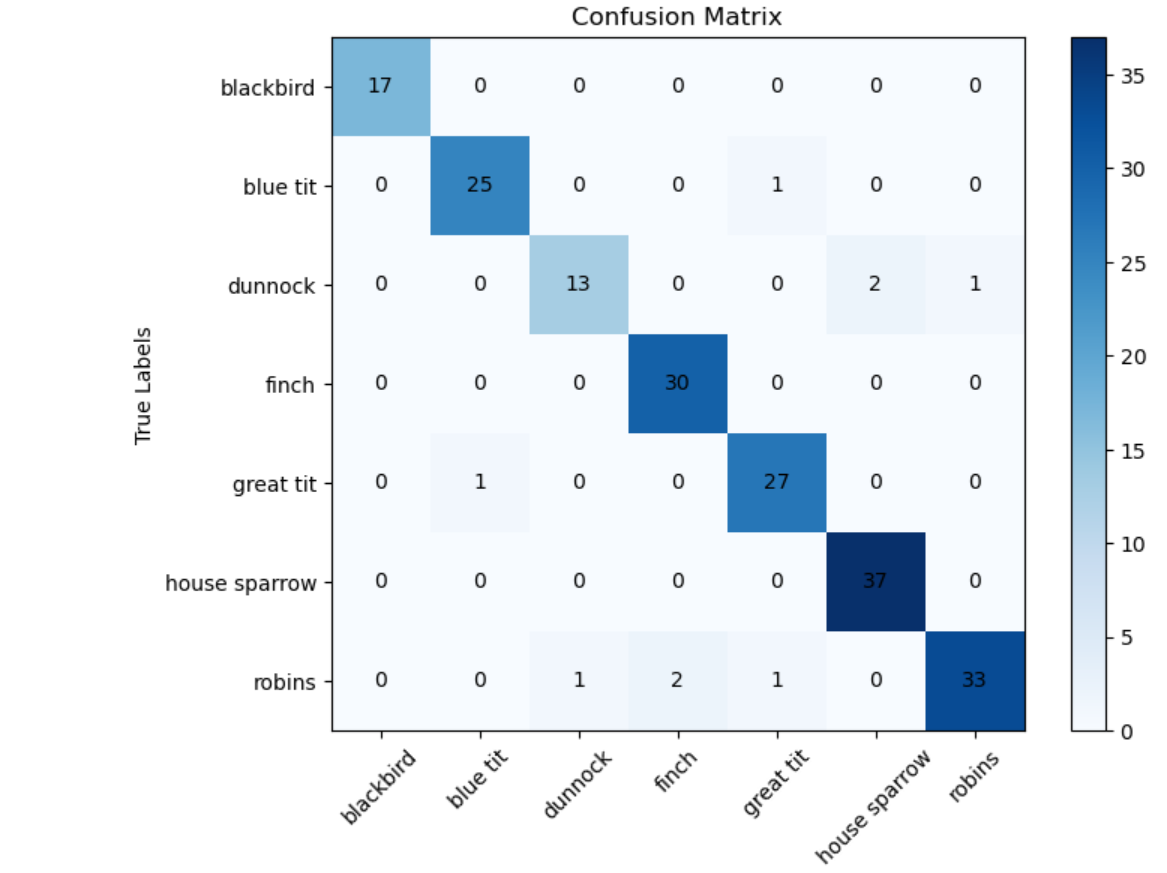
Model achieved 95.2% test accuracy with consistently high scores (92-98% precision, 92-100% recall) for all 7 bird species. Transfer learning with MobileNet made these results possible with relatively little data. Complete Figma prototype developed with camera interface, spotting hotspots map, and species directory. A/B test with 10 users showed preference for colorful design variant. Project demonstrates complete ML pipeline from data collection to production-ready model with user-friendly interface.
The project demonstrates the complete machine learning lifecycle: from collecting and annotating custom data via Google Image Scraper to a production-ready model with 95% accuracy. By combining transfer learning with MobileNet with data augmentation, excellent results were achieved with limited training data.
MobileNet is specifically designed for mobile deployment and offers an ideal balance between accuracy and efficiency. The pre-trained weights from ImageNet provide a strong foundation for feature extraction, achieving better performance even with a relatively small custom dataset of ~400 images per class.
The model achieves consistently high scores across all bird species:
Confusion matrix analysis shows that classification errors mainly occur between visually similar species:
Complete app interface designed in Figma with focus on intuitive navigation and clean visual hierarchy:
Direct camera access for instant photos or upload from gallery for identification
Map with popular birdwatching locations for community engagement
Overview of most common species with search functionality
Extensive information per bird species with characteristics and habitat info
An A/B test with 10 users showed a clear preference for the more colorful variant. The vibrant colors resonated better with the nature theme and made the app visually more appealing to the target audience of birdwatchers and nature enthusiasts.
"Presentation to instructors was received positively. The combination of high model accuracy (95%) and a well-developed Figma prototype showed that both technical and design aspects were well executed."